Showing posts with label video games. Show all posts

Monday, January 15, 2007

A Timeless Question, or, Gaming to Learn


The BBC reports West Nottinghamshire College teachers used Atari's Neverwinter Nights to reach "disaffected" students and improve their literacy and numeracy skills. Research on the project found that successful learning of key skills had tripled, to 94%. Over 700 learners played the modified game, which cost $25 million to develop from the original game.

Long before I got into video game theory I was working as a instructional designer for e-learning tutorials (my lawyers tell me not to disclose any further information on my employers). Anyhoo, I read a lot about the use of 'interactive' tools like games for learning, with many e-learning folks in favor and traditional book-learning people against. The whole design of online learning is geared toward mainly basic skills such as grammar, writing well, etc. because the quick delivery method is posited to lend itself well to lower-wage, perhaps non-English learners without the time or money to go to the community college for courses. Furthermore, rather than pedantically telling the learner the parts of grammar, these tutorials largely teach through examples, scenarios, questions, and tests, thereby immediately putting all knowledge into action.

We have known for a long time that there are many kinds of learners, tactile, auditory, by-experience... Most of these courses work on all levels, comprising audio elements, learn-by-doing activities, etc. And to me, games always seemed an excellent avenue for this.

Later, I read a chapter in the Video Game Theory Reader on an experiment at MIT where a few games were developed with loads of money to teach university-level students. The most compelling game was one that allowed students to better understand the obscure physics theories that could not be experienced in life through game mechanics. Instead of memorizing a theory, they were feeling it as they hurtled through space. Genius, I thought. Too bad most places do not have a third of MIT's budget, or $25 million to mod Neverwinter Nights.

But do we need that much money? Are we spoiled forevermore by the graphics, interfaces, and engines of commercially-produced games, to the point that anything lesser would be more remarkable for its cruddiness than its lessons? Why did that college need to use such a sophisticated game to teach area and volume anyway?

Perhaps the best route for delivery of teaching games would be through the same companies that make textbooks. If the cirriculum endorsed a game made by a familiar name, they would be in the schools and the bookstores. But I cannot envision a game labeled McGraw-Hill Ryerson, can you?

Tuesday, January 09, 2007

Slamming Slamdance for its Slights

Some pretty big news in the game world this week doesn't come from reports on sales figures but from a controversy generated by the Guerilla Gamemaker Competition of the Slamdance Festiva;. After courting the game, electing it by jury, and advertising and promoting its status as finalist, the organizers pulled Super Columbine Massacre RPG from the competition. The game is pretty much what it sounds like, that is to say you role-play as Harris and Klebold on the fateful morning of the Columbine Massacre. In all likelihood, this description elicited either of two reaction from you, either complete disgust that anyone could make a game of such a tragedy, or that this is just in line with the production of fiction films like Gus Van Sant's Elephant that explore one of the darkest moments in recent history.

Needless to say, this variation in potential reactions is fueling a pretty big debate and backlash. Besides a number of debates raging on the usual gaming sites, Grand Text Auto, The Ludologist, and Water Cooler Games are reporting that Brad, flOw, and Everyday Shooter have dropped out of the competition in protest.

Before you pass further judgement, take a look at some screenshots from the game here. The two quotes at the bottom (and their inclusion) are to me very telling. The whole issue also seems to drive home the question of what games can do, and what they as a form are allowed by the media and the public to do.

Wednesday, January 03, 2007

They Took Away My Free Skype So I Will Blog Instead

Since I am on a graduate school hiatus (that awkward time between defending a thesis, graduation, and hearing back from PhD programs), I am suddenly overwhelmed with ideas and potential arguments for papers. Of course, this could be due to the fact that ideas are easy, its implementation that's work, and I have no real pressure to do the latter. On the other hand, it may be because I have time to canoodle and browse articles at my leisure, without having to preserve brain space for positions only relevant to my thesis.
Three ideas in particular keep bopping around my skull. I have had more, but they seem to largely require extensive ethnography in Asian countries, and I am currently SSHRC-less. These other ideas are theoretical and in some ways interrelated.

1) The Holy Grail- I posted about this before. What makes a game fun? What makes MMOGs work as immersive environments? What is that elusive element of games that everyone knows about but universally cannot put into words, theory or design. So instead design is often based on hardware capabilities like improved graphics, tried-and-true franchises, and gimmiky personas. Theory attends to other dimensions of games like structuralist analysis, discussions of representation, and studies of gameplay experiences. This leads to-

2) Smackdown Academics Vs. Designers- Otherwise known as Ivory Tower-supported anti-intellectualism. This is exemplified by the article “Immersion Unexplained” in Issue 57 of The Escapist, which charges academics with discovering how immersion works but dismisses the work done thus far by video game theorists, argued to be mainly semantic quibbles. Varney, who is a game designer, sums up the long and complex narratology versus ludology discussion as “airy palaver” (p. 22) and “buffleheaded pedantry” (p. 22). He charges academics to "get a job" (p. 22), preferably in game development. Varney is fixated on what amounts to the dismissal of academia and its work. This is simply representative of the derision felt by some game designers and industry heavyweights toward academics, and the sentiment that academics merely talk about games without ever playing them. As Andrew Stern writes in his response to Varney’s article in the Grand Text Auto blog, the pursuit of knowledge is not by definition necessarily applicable to the building of anything, including immersive video games.

3) Slacker Games- This leads nicely into my third fascination, which is thoroughly unprofitable to game design, and that is pinning down what makes a game a game. No not fun. Just a game. Because I think tying down a definition can be productive, and yet people seem to really like messing around with them. Jesper Juul, for instance, just posted his newest article, on games without goals. This piques my interest because I would argue that games require goals just as much as they require rule systems. I haven't read through this article yet, but his examples of GTA, The Sims, and Wow (all games I have played and enjoyed) are all to me totally wonderful examples of how goals can vary, not of how games can be termed as such without goals.

So I expect that more posts shall follow in the line of these 3 interests, especially since I have some reading to do, and reading is more fun when you can write about it later.

By the way, anyone know of a good free replacement for my beloved lost Skype?

Tuesday, January 02, 2007

Game On In 2007

Happy New Year! Every year, news outlets, websites, and TV specials commemorate the previous year and make predictions for the next. In honor of this timeless tradition, I will highlight some that I have seen in my first post of the new year.

Kotaku's 2007 predictions and choice 2006 moments were turned over to readers to decide. Resoundingly the Wii was posited to be the surprise of 2006, and price drops on xBox 360s, PS3s and Wiis in the New Year one of the predictions. Many were looking forward to Wii developments, such as a colorful version, connectivity, and more games. I was tickled by chibihobo's comment, "i think 2007 will be a big year simply because people will not be buying old generation hardware anymore". We got a Sega Dreamcast over xmas...


Terra Nova predicts Second Life backlash and takes bets on 13 possible media stances over 2007, with #13 being that the outside bet that the persistent virtual environment turns out to be as wonderful as originally imagined. I see #6, #8, #10, and #11 as most likely, just based on historical evidence of media and popular reactions to other media.

Joystiq and Gamespot chose Gears of War as game of 2006, despite EA's report that Madden NFL 07 was the best-selling game of the year and that many other random reviewers cited The Legend of Zelda: Twilight Princess. Whatever, comparing shooters and action games goes against my beliefs in genre-specific analyses. Check out X-Play best of list here.

My predictions? Video game studies is fueling up to be even more dynamic in 2007. Just before the ball dropped Game Studies published a new (and long-awaited) issue and receiver magazine released a special issue on gaming and playing. Games and Culture journal released a call for papers for a special edition on Asia-Pacific Game Studies that emphasizes the importance of local studies of game play using the example of Korea's public play and Japan's private gaming. DiGRA 2007 hits Tokyo this September, students and profs alike have a backlog of books from 2006 to catch up on, and all signs point to a hot year for video game studies. I can hardly wait!

On a personal level, I finally got my own copy of World of Warcraft so I can guild and make as many characters as I like without pestering my brother for time on his account.

Do you have any crystal ball insights for the upcoming 363 days?

Wednesday, December 13, 2006

What About Thesis Defenses and Flow?

So I am happy to announce and revel in the completion of my Master's thesis defense, where my 144-page tome was 'accepted as submitted', which is as good as it gets. I had a very lively and dare I say fun Q&A session with my committee which included Dr. Leslie Shade, Dr. Marty Allor, and Dr. Kim Sawchuk.


Already moving on... my next beautiful, virgin research area will be the intriguing question of flow in video games. From what I have seen, most people are referring to the work of the psychologist Mihaly Csikszentmihalyi. According to Wikipedia, Csikszentmihalyi uses flow to describe "the feeling of complete and energized focus in an activity, with a high level of enjoyment and fulfillment". So flow would describe the engagement experienced in sports, playing an instrument, and the play of video games.

This leads to preliminary research in psychological research on affect, cognition, motivation, and flow. A tad dull, but I know it will be worth it for when I can move into computer and science and technology studies to get in deeper into this topic.

Jenova Chen's MFA research popped up, and I must say that game is very pretty but not altogether addictive. Her thesis looks fairly interesting though, as I think flow is an intriguing way to get at game design. I'll keep you posted!

Nice to be back...

Wednesday, November 29, 2006

The Hardcore Casual Gamer

Today I deposit my Master's thesis at the Thesis office at Concordia, which is basically the last official step before my thesis defense on December 11. Unofficially, I will be madly rereading my references and trying to remember how I had these brilliant thoughts last February.

Anyhoo, in the second-to-final edits of the thesis, my supervisor Dr. Leslie Shade asked me to include within my third chapter, which is centered around case studies of 7 video games, my own particular position as a gamer. In other words, to answer the question- what kind of gamer are you? Upon a little thought, and research into what defines hardcore and casual gamers, I included within my thesis the designation of a hardcore casual gamer.

No, this isn't a slippery way of getting out of the question. Rather, it highlights the variety of dimensions that comprise the definitions of both hardcore and casual (nevermind the ferocious denigration connoted by each camp when discussing the other). I am a hardcore gamer simply based on the numbers per week I play video games (typically over 10 hours a week). I am a casual gamer because of the types and range of games I play. Besides World of Warcraft, I play mainly 'soft' video games, especially the simulation games I so enjoy mastering and the classic games like Super Mario Bros. I play on my emulator. I also play a few games dedicatedly and repeatedly rather than playing rapidly to completion and then moving on to another game.

As a state of mind, I would say I am a casual gamer, playing for pleasure with little motivation to play new games, but hardcore in terms of interest, seeking news daily on a salmagundi of sites and blogs daily. How would you classify your gameplay? Where do you stand on these labels, which are so pervasive I had to include them in my thesis?
Or are you simply what Kotaku calls an insane gamer, like this poor soul?

Thursday, November 16, 2006

From French: To Stick


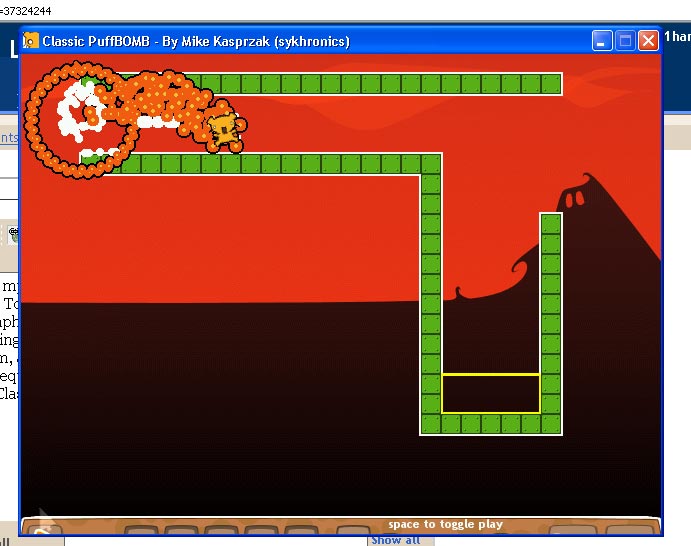
Just wanted to post for posterity, since my few days turned into nearly a week, and give a shout-out to Ryan for creating my new Too Much Media, Too Little Time banner collage. With some of my fave pop icons and iconography, this collage is a colorful reminder to me of some of my favorite forms of mixing and matching. From the technique of photomontage to the creative and ironic mashups like the Grey Album, a remix of Jay-Z's Black Album and The Beatles White Album. It would seem that the gaming equivalent is the Surrealist game, as found at The Experimental Gameplay Project. Play Classic PuffBOMB for some good laughs and physics practice.

Thursday, November 09, 2006

What Motivates You in Gaming- Pain or Pleasure?

So yesterday I sent in my application for a PhD position at the University of Amsterdam within the School of Communications Research. In the Netherlands PhD students occupy a sort of space between student and researcher that commands a salary, an office, and benefits but also can, as with this position, require the student to complete up to 5 years of research on the lead professor's project of study. I was in the process of devising one of these positions, called an A.I.O., with Professor Joyce Goggin (another Canadiana in Holland) on boys and virtual spaces, when this job ad came up.

Pain and Pleasure in Gaming is a pretty engaging topic I think... especially statements like "self-determined forms of regulating gaming activity contribute to stronger positive affect and lessened impact of negative affect on persistence". Over at Terra Nova there was a post today on grinding, which is when a player is required to kill simply to level, an activity that is pretty much a fact of life in my WoW play, as I have no urge to be slaughtered by a Level 15 boar at Level 10, though a quest may require me to wander where these superior beasts tread. What makes the player get through the grind and still revel in this as play? I think, after all the bantering about ludology vs narrative, these are refreshing and more vital questions for the field. So I hope to work with Dr. Tan on this project, or at the very least communicate with him when I am at UvA working on my own research (if of course that is where I do go). Sorry to sound so cagey.

In case you're wondering, the picture is of a gynormous LAN party, looks like its somewhere hot.

Wednesday, November 08, 2006

All You Can Say is... WoW

So the most recent edition of the academic journal Games and Culture was dedicated to articles on World of Warcraft, aptly abbreviated WoW, a phenomenally popular release in the genre of massively-multiplayer online games (MMOGs). Previous to writing my thesis, I had always found the idea of these games compelling- they truly do seem to represent digital 'third spaces' (see Steinkuehler and Williams' "Where everybody knows your (screen) name: Online games as 'third places.'") , or at the very least microcosms of social life accessible to those interested in a variety of questions ranging from the economic to the cultural to the legal. But it was only when I was engaging in case studies on seven varying genres for my thesis that I actually created an avatar and joined the huge numbers within the WoW universe.

Even though I found it to be a game that managed to strike a balance between an immersive persistent world with lush settings and well-plotted landscapes and a game with a series of at times repetitive quests required to allow the player to level sufficiently high enough to progress through said landscape, I became one of the statistics in Ducheneault et. al.'s abandonment rate after getting to level 9, largely because I was killed on a distant island and felt too aggravated to find my corpse again (in proof of their statistics on class and abandonment, I was a shaman).

But upon reading this journal, I felt compelled to again take up Mashyla, my dwarf shaman, and see if I couldn't get past those nasty voodoo trolls and further into the game.

My persistence (truly, I was killed another 18 times on that quest, so persistence may be another word for obsession) paid off. I made it to the Crossroads, where a quest led me to my first flight on a winged beast, over the landscape I had spent hours running across, to the huge commercial centre of Orgrimmar. Huzzah!

All this to say, stay tuned for lots and lots of WoW posts in the future. Every quest you complete and level you reach opens up new terrains, trickier quests, and meaner enemies, as well as greater oppportunities to meet other players. Reaching Orgrimmar opened up whole new channels of communication, and in the time it took me to disembark, I saw more real other players run by than my entire time playing. It seems to me like it may just be time to put my own post onto channel 4, LFG.

Believe it or not, I never used to be a video game geek before this game.